

A Practice for Ataraxia
The Stoic goal isn’t just calm. It’s something quieter than that.

There’s a word I keep coming back to. The Stoics used it constantly, but most people skip over it because it sounds academic. Ataraxia. It translates roughly as “freedom from disturbance.” Not happiness. Not peace. Freedom from disturbance.
I’ve been thinking about this distinction because of something that happened last week. This week has been a bit of a hard one for me. I’ve been training a lot and dieting, and I can feel this fatigue accumulating, as well as a lack of patience, in my system. Nothing was wrong externally. No crisis. No argument. Just a vague sense that something needed my attention, that I should be doing something other than what I was doing.
And I realised — I wasn’t being disturbed by anything. I was disturbing myself.
That’s the thing most people miss about ataraxia. We assume our inner turbulence is caused by outer events. The meeting went badly. The message was rude. The news is terrible. And sometimes it is. But more often than I’d like to admit, the disturbance is self-generated. My mind producing noise in the absence of signal.
Seneca saw this with painful clarity:
“We are more often frightened than hurt; and we suffer more often in imagination than in reality.”
— Seneca, Moral Letters, 13.4
You don’t need a crisis to feel disturbed. Your mind will manufacture one. And the manufactured version is often louder than the real thing, because at least real problems give you something to do. The imaginary ones just circulate.
There’s a useful parallel in psychology. Researchers call it the “default mode network” — the part of your brain that activates when you’re not focused on anything specific. It doesn’t rest. It generates. Worries, scenarios, imagined conversations, replays of things that already happened. Your mind, left idle, doesn’t default to peace. It defaults to noise. The Stoics didn’t have the neuroscience, but they had the observation. Seneca practised evening review precisely because he’d noticed that the mind, unchecked, will disturb itself all day and then keep going after dark.
The Epicureans had the same goal — ataraxia — but their solution was to withdraw. Remove yourself from the things that disturb you. The Stoic answer was different, and harder. Don’t withdraw. Stay in the flow of life. Just stop adding your own unhelpful story to it.
That’s why Marcus Aurelius could write a journal about inner stillness from inside a military camp. He wasn’t trying to escape the war, the politics, the disease, the people constantly needing things from him. He was training himself not to be the source of his own disturbance on top of all the rest.
The practice isn’t about becoming calm. It’s about noticing how often you disturb yourself — and stopping.
This week’s practice
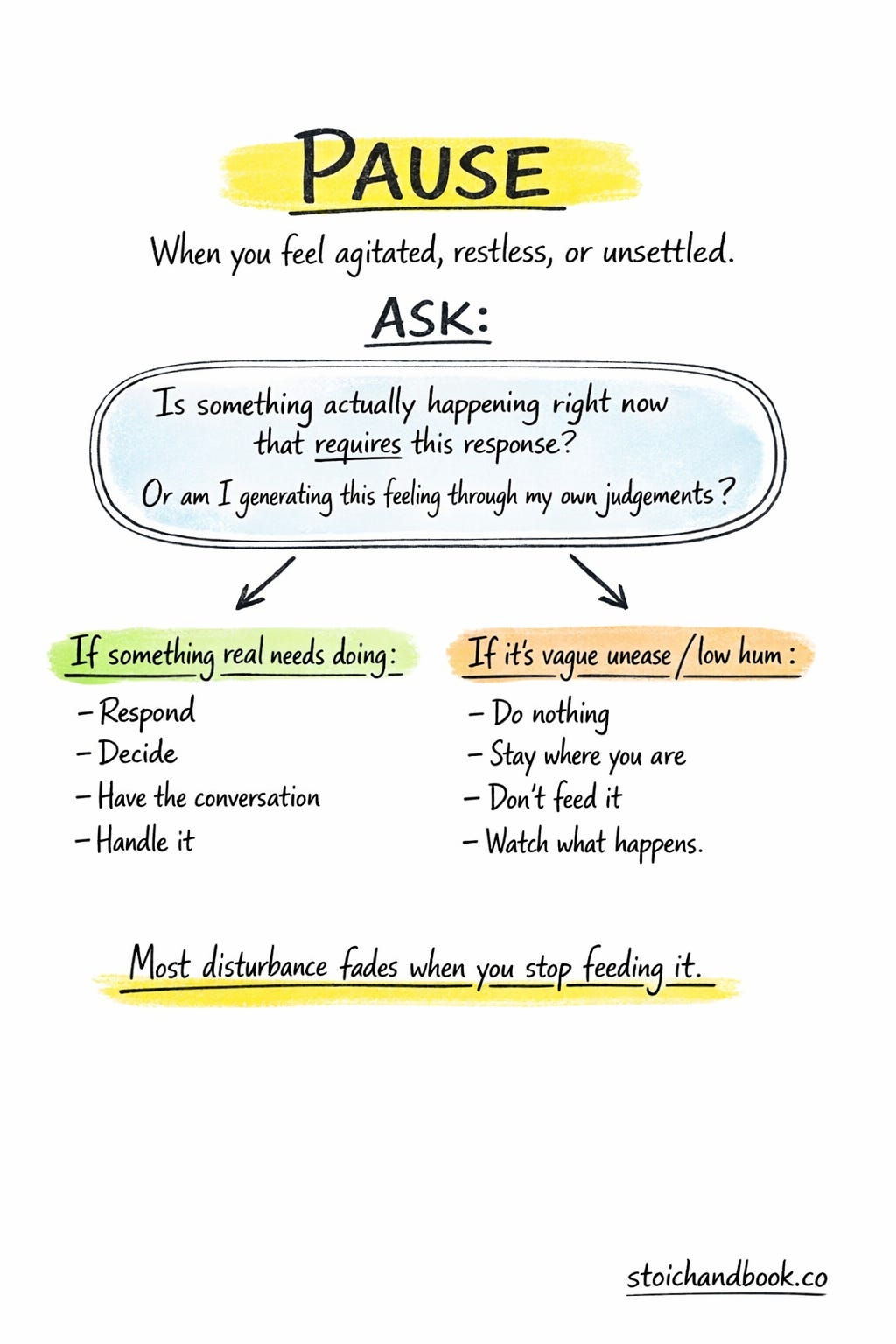
Pick one moment each day when you feel agitated, restless, or unsettled. Before you do anything about it, pause and ask one question:
Is something actually happening right now that demands I feel this way, or am I generating this feeling due to my own judgements?
That’s it. Don’t try to fix the feeling. Don’t argue with it. Just locate it. Is this disturbance arriving from the world, or am I producing it internally?
The temptation will be to blame the event, most of the time. But just ask, is this feeling and response demanded of me. Or am I co-signing the feeling with reality.
If it’s real — a genuine problem, a decision that needs making, a conversation you’re avoiding — then deal with it. That’s not disturbance. That’s life asking something of you.
But if it’s the other kind — the low hum, the vague unease, the feeling that something is wrong but you can’t name it — try something different. Do nothing. Stay where you are. Let the feeling be there without acting on it.
Watch what happens when you stop feeding it.
Most of the time, it dissolves. Not because you solved it. Because there was nothing to solve.
The hard part
The hard part is that self-generated disturbance feels exactly like the real kind. Your body doesn’t distinguish between “the deadline is tomorrow” and “I have a vague sense that something is wrong.” Both produce the same restlessness, the same urge to move, check, fix, respond.
The practice is learning to tell them apart. And the only way to tell them apart is to pause long enough to ask the question.
Which is exactly what the agitation doesn’t want you to do.
Sit with the question for a week. Notice how often the answer is: nothing is actually happening. I’m doing this to myself.
That noticing — quiet, honest, without drama — is the beginning of ataraxia. Not the absence of disturbance. The decision to stop creating it.
If you want to practise this with others — with weekly exercises, discussions, and a community of people doing the work — that’s what The Stoic Vault is for. A quiet place to go deeper.