

The Practice: The counterfeit detector
Before you believe an impression, check what it is worth.

Yesterday, I had my VO₂ max tested for the first time.
For some reason, I had already decided the number would be low. Maybe thirty-seven or thirty-nine. Something that would confirm the story I’ve carried for years: I’m not particularly fit.
I told myself it didn’t matter. At least I’d have a bad score to work from.
The result was forty-five.
The man running the test classed it as excellent. He seemed genuinely impressed and told me I had a good engine and a lot of potential.
I felt good, but mostly I felt shocked. My VO₂ max wasn’t the problem. Other parts of my fitness need work, but not the part I had already convicted.
The strange thing is that there was another voice underneath the whole time. A quieter one that thought I might actually be quite fit.
I hadn’t allowed that impression in. The negative one had required far less evidence.
The source
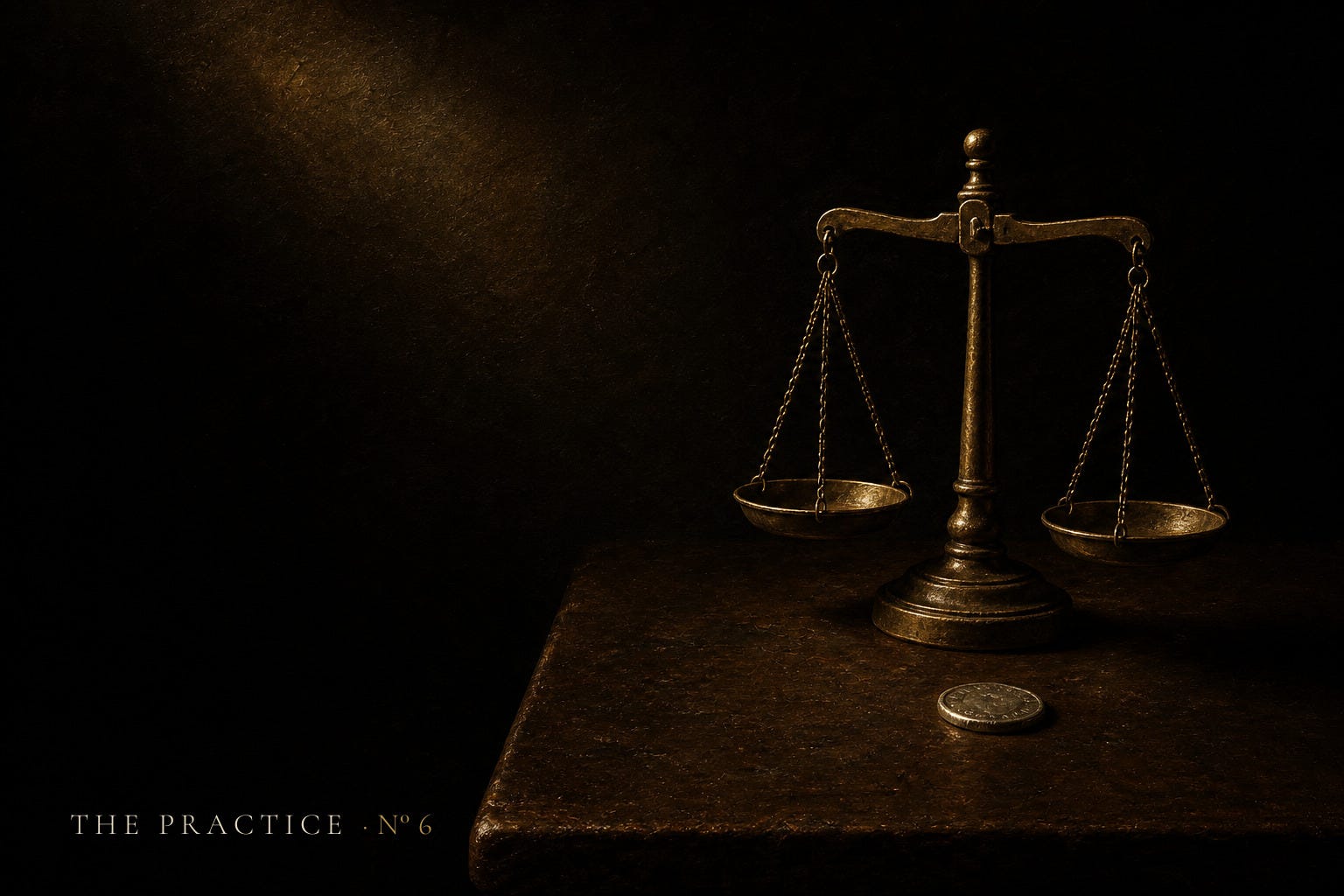
Epictetus, Discourses 3.12.15, in Oldfather’s translation: “This is the task of a real student of philosophy. To know the value of impressions, and to test each one as the money-changers test coins.” The money-changer is the whole point. He does not refuse the coin and he does not pocket it on sight. He has a procedure, and he runs it before the coin goes anywhere near the till. Most of what arrives in a day arrives already stamped with a value, and we accept the stamp because checking is slower than believing.
The drill
Pick one impression you have never actually tested. Not a category, one sentence you say to yourself: “I’m not fit”, “they’ve gone quiet on me”, “I’ve left it too late”. Write it at the top of a page. Underneath, write the cheapest piece of evidence that would settle it, and who could tell you in a single message. Then get it. Once, this week. The measurement is not the interesting part. The interesting part is how long you had been spending the coin without ever weighing it.
From the archives
The impression I never tested had been talking to me in the same voice for years. Stoic Morning Practice: Quiet The Inner Critic is a short guided practice for exactly that: separating the bare facts from the judgements the mind adds automatically, and hearing the critic as opinion rather than fact.
https://www.buzzsprout.com/1882875/episodes/19330398-stoic-morning-practice-quiet-the-inner-critic
What is the impression you have been spending without ever testing? Hit reply with the sentence.
Go well,
Jon.